Saturday, April 26, 2014

It's official: A Spanish language writer

One morning in the last February, I received a surprising invitation from the famous Spanish novelist Luis E. Prieto to register myself as a writer who writes in Spanish language. I was trilled first and I thought that some of my Spanish texts were already published in Argentina, Peru, Spain and Puerto Rico. So, probably due to that reason, the readers or the writers from that sphere may know me. As a lone representative from India, I registered myself in REMES ( Red Mundial de escritores en espaƱol ) with all required details and they honored me as a Spanish language writer within a few days. They also invited me to write in Spain and Latin America based Spanish literary magazine and immediately after this great honor, their own literary magazine PALABRAS DIVERSAS  as a new voice of poetry with my small literary curriculum.
To read my poems in this magazine, please visit:  http://www.palabrasdiversas.com
To see me as a Spanish language poet, please visit: http://www.redescritoresespa.com/A/adak.htm

Venture with Photography

Sunrise: my snap: 2014
I never thought seriously about photography, though I possess a very simple Nikon camera just to keep with me so that I can take photos of my clients from abroad as a proof of work or better to say, as a memento of reminiscence. Since the middle of 2012, I started taking photos of my garden and village and the places around my village just to kill the time and to see how much I can interpret well through this camera. But, practicing rigorously with it, I found some photos came excellent even through this camera. It boosted my encouragement and I continued to take photos of nature. Then, since 2013, I started taking photos of my city Kolkata, the moods of people, situation or a fragrance of moment which tells a story. Though the photos didn't come as a professional, but they could able to interpret the story line. By this time, I bought a smartphone also through which I started taking videos which energized me much more than before. When, I decided to travel to the places of Pallava dynasty last November, one of my students, after going through some of my snaps, encouraged me to take it seriously and to take photos of Pallavas in such a way so that I can be reached at entire world by representing these mind blowing places. After coming back from a successful journey, I first uploaded some photos to Flicker and got some nice response from the co-photographer of that site, which pushed me to register in National Geographic Magazine and other well known photography sites as well . By posting some selective snaps of mine, I became quickly known as an active family member of photography which is now a very serious topic to venture with.
To see my snaps, please visit: http://yourshot.nationalgeographic.com/member/863239215814
And https://www.flickr.com/photos/108258769@N03/12045444634/
My another snap : 2013

Sunday, April 20, 2014

Kolkata Book Fair 2014: The Most Unforgettable Book Fair

Since 2008, I'm deeply attached to the Kolkata Book Fair as I participate as a volunteer and member of Indo-Latin American Association & Spanish Study Center. But this 2014 Book Fair is the most memorable experience till now in my life.
Our Pavilion
As a participant, I worked not only in our well known pavilion but also we were invited to have seat in the pavilion Peru, the Focal theme of the Book Fair.
Me in our pavilion
We were to explain the Peruvian culture and literature principally to the visitors who couldn't realize the Peruvian display of  posters and books as all of these were presented in Spanish.
Our team with Francesca Denigri 


At the same time, we were to sell our translated books
the visitors

which included Poems of Peru, a travel log of Peru in Bengali ( Pothe Pothe Peru by Asesh Kumar Ray) , fourth edition of Natural History of Peru of Inca Garcileso de la Vega, Peruvian Traditions by Ricardo Palma etc. As we know that this is the melting pot of poets, singers, artists, I personally had to talk with contemporary Bengali novelist Abul Basar, composer and singer Anupam Ray etc when they visited our pavilion. Above all, our collaborated translation work Poems of Peru was also inaugurated in the presence of Peruvian Ambassador in India Javier Paulinich, poet Francesca Denigri and I was also a part as a translator of this work.
Reading program
What made me more encouraged was to see the more people interested in Latin American and Spanish culture and their vivid interaction with us, which seems far better then the scenario of 2008 when I participated for the first time.
Me with another participant Arjun in Peruvian pavilion

First book where I colaborated

30th January is one of the unforgettable days in my life. Our language academy Spanish Study Centre has done a collective plan to publish a Bilingual translation of Poems of Peru as this year in Kolkata International Book Fair Peru was the Focal Theme.
Inauguration of the book
Accordingly, I was awarded to translate few selective poems of  Jorge Eduardo Eielson, Jose Maria Eguren, Jose Santos Chocano, Porfirio Mamani Macedo and Yamili Yunis Herrera into English. With me the other collaborators included the chief Editor Asesh Kumar Ray, translators Atasi Chatterjee, Mahua Dutta and Prof. Rabin Pal.
Francesca Denigri is reading from the book
We finished our part much before the Book Fair started. On the eve the presence of Peruvian Ambassador in India Mr. Javier Paulinich, the book was launched. Our Editor in chief shared some moments about how much we struggled to translate and also our experience with this project. The Peruvian poet Francesca Denigri was also present in that over-crowded occasion. On 5th February in the same venue ( Pavilion of Peru) we were invited to read from the book and discuss about the translation with the cultural attache of Peru -Mr. Enrique Noria. Each of us read our own translations and then shared our points how much we had to struggle to reach at the quality translation of these eternal poems.
Reading my translation on 5th Feb.
Personally, I had to think a lot from point and view of an English speaking reader and how that reader can visualize a Peruvian poem through his/her perspective. But above all, it was a milestone in my tiny literary journey. The book is named 'Poems of Peru: Perur Kobita'

Posing with the book

Tribute to Bibhutibhushan Bandopadhay

His House
The entrance


Sunset at Ichchamoti
Recently, I visited the India-Bangladesh frontier village Panitar, just beside the river Ichchamoti. Panitar is not  only well known as one of the most important  frontier villages, but it is the birthplace of Gauri Devi, the first wife of famous Bengali novelist Bibhutibhushan Bandopadhay. He also stayed there for almost one year after their marriage and wrote some beautiful novels depicting the calm and quiet village ambiance with busy river. Unfortunately Gauri Devi died before giving birth to a child in 1928 and then , Bibhutibhushan left this place with grief, though he visited Panitar many times after the death of Gauri Devi, few times with his second and last wife Roma Devi too.
Mustard field
From then on, people call the house as Bibhutibhushan house and Gauri Devi's house as well. Now the house is in a wretched condition with the library in front surrounded by big trees an a white statue of him. When, I touched my feet to this land, I felt the beauty of silent nature what was mostly described in his entire writing.
Me beside his statue


Friday, January 3, 2014

14th International Conference in Lucknow

I was honored to be a part of the 14th International Conference of the Chief Justices of the World ( 11th to 17th December, 2013) in Lucknow as a Spanish & French Interpreter . It is my consecutive 4th time to work there with the chief justices. This time, the judges came from Argentina, Costa Rica, Bolivia, Nicaragua, Ecuador, Peru, Chile, Paraguay, Brazil, Congo, Comoros, Ghana, Tchad, Madagascar, Lebanon, Tunisia etc.
Me with Sra. Patricia Gonzales, Paraguay & her husband

With our team of Spanish & French, we had to attend simultaneous interpretation in auditorium box, consecutive interpretation on the auditorium stage, parallel session discussion and question-answer session in Conference halls and TV interviews. As, most of the interpreters of our team has previous experience to work there and I'm one of the most experienced interpreters in this conference, we didn't have to struggle to get accustom with the type of job, though this is one of the toughest job in language sector.  For me, it's a get together of  every year with the respected judges and friendly officials of the organization.
Me with Ana Maria Conde, Argentina and Sumit

This time, I was very involved with Argentinian judges, so, I had to skip the TV interviews, I was only parallel sessions from 14th to 16th December, and simultaneous interpretation in box. It is a nice experience to be a part in the conference and obtain more specific knowledge of the judicial sector.
Me with Juan Manuel Matera & Edgardo Bello, Argentina


As a learner to Pallava Dynasty

Work without break gives us not only physical stress, but also makes the professional life monotonous too. Planning to take a short break after 5 years of work, finally, I planned to visit the specific places of Pallava Dynasty in southern part of India, which not only brings me a freshness in life but also to face our heritage and learn about its depth. On thinking to make an adventurous trip, I went alone to Chennai where I was invited as a guest to a Tamil family to celebrate the biggest festival of India - Diwali with Tamil tradition. They welcomed me with warmth as if I'm one of their family members. After watching a different sort of Diwali celebration which is quiet different from from my city of east o even from North India, I started my adventure from very next morning of Diwali. It was the beginning of November, so the weather in Chennai and its neighborhood is far better than any other time to roam around the places.
Arjun's Penance in Mahabalipuram

First day, I went to Mahabalipuram, the ancient city of Mamallapuram where the Pallava kings depicted their creativity in cave sculptures in Mahabalipuram caves, Pancha Rathas and also in Sun Temple area. Most of the existing statues are of 7th and 8th centuries depicted on Sand stone, though the work was started from 2nd century. Lot of French tourists use to visit this ancient town, as it is very near to Pondicherry.
Next day, I went to the capital of Pallava kings, i,e, Kanchipuram which almost 70 km west from Chennai. Kanchipuram , also known as Kanchi, is nowadays is famous for its sari and as the city of 1000 temples though most of them are demolished by time, now 150 temples exist only and 20 among them are well- maintained for visitors and devotees. With the help of an auto rickshaw I managed to visit 15 of them within 4 hours, the driver was friendly and became my guide to show the famous temples, houses explaining significance of some places.
Corridor of Sri Ekambaranathar Temple in Kanchi

On third day, I went to Thirukazhukundram village to visit the Eagle temple which is known also as Pakshithirtham. It is also a part of Pallava dynasty, established by one Pallava king 1200 years ago. There are 2 parts of the temple, the biggest one in plan land on which the entire village is surrounded and the hill temple where till 2004 the Eagles use to come at 12 pm everyday to take Prasadam from the priests of the hill temple. To climb to the top of the hill is not an easy task, but after reaching there, I've seen a beautiful view of village, far landscape, nearest city Chegalpet, the big tank of the temple beside the hill and the temple at the bottom. The priest also offer Prasadam to each visitor in the hilltop temple. Due to difficulty to climb, most of the visitors avoid this temple. But, for the sake to viewing the natural beauty of that place, every visitor should try to climb, it would be a life-time experience if you reach there with a camera.
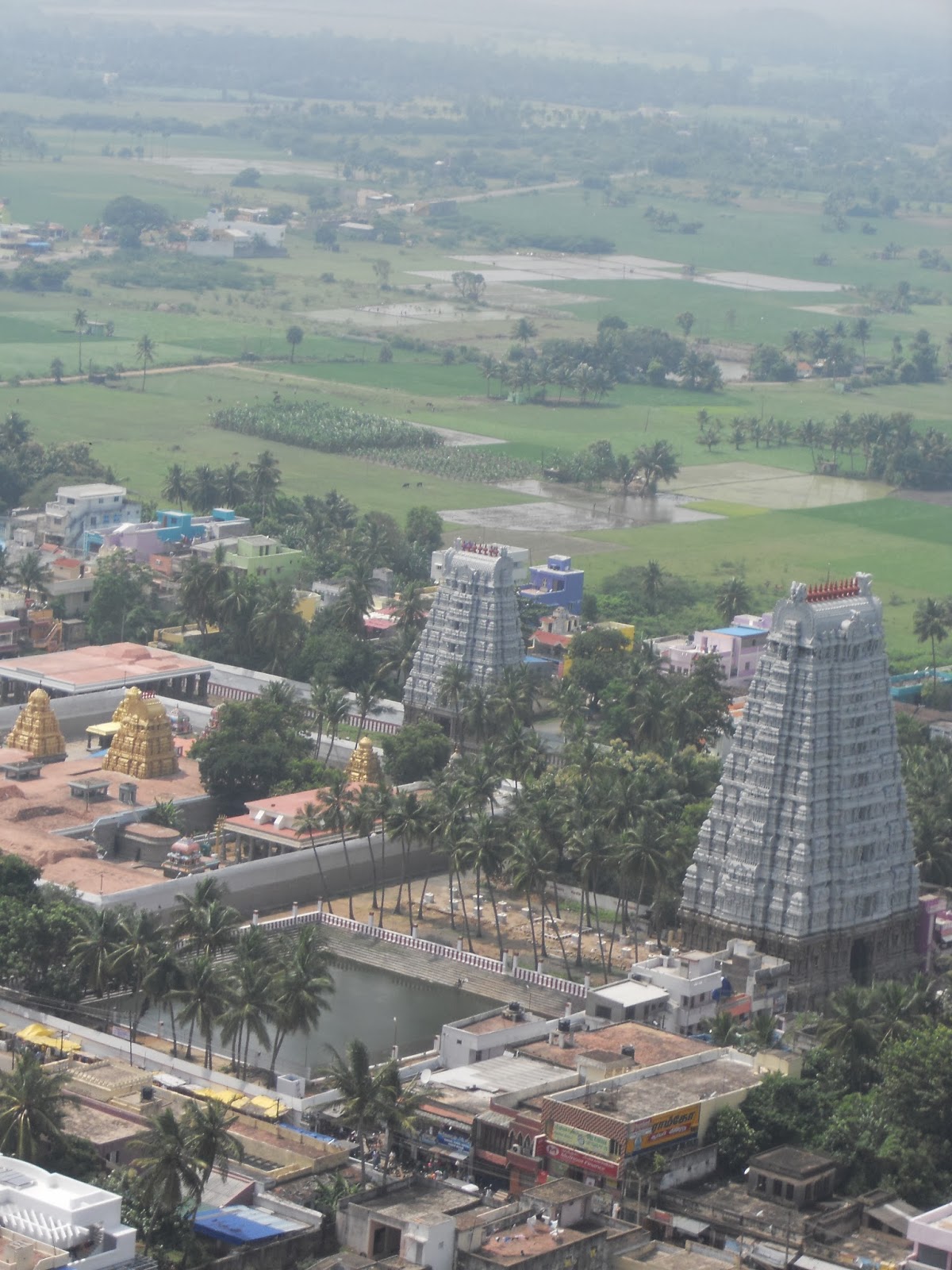
Vedgiriswarar temple in Thirukazhukundram
From Mahabalipuram to Thirukazhukundram, it's like a dream journey to come back to the lap of my motherland. A history book can give lot of information of an era, but to feel the era, the best way to visit that place.
Chegalpet Lake